Have you ever realized that a true Biohazard & Trauma Scene Cleanup requires far more than standard household cleaning supplies? It is a heavy, overwhelming feeling.
Our team knows that dealing with these emergencies takes true professional care, privacy, and the right tools for the job. Strict safety rules from the Occupational Safety and Health Administration, or OSHA, guide every single step we take. We use powerful hospital-grade disinfectants registered with the EPA in the US to neutralize threats that standard household cleaners simply leave behind.
These advanced solutions ensure your home is genuinely safe again. Our trained technicians handle blood, bodily fluids, and trauma scenes with the total dignity, discretion, and speed your family absolutely deserves. To take the stress off your plate, we even coordinate directly with your US insurance carrier, the same way our hoarding cleanup and biohazard remediation team across Greater Cincinnati does on every project.
Let me walk you through exactly how the process works so you can make the best choice for your home.
What Is Biohazard & Trauma Scene Cleanup?
A biohazard is any material that can carry infectious agents. In a normal home environment, this usually means blood, bodily fluids, tissue, or waste. The real danger is almost never limited to what you can actually see with your own eyes.
Fluids travel quickly. They run along baseboards, soak deep into carpet padding, wick up into drywall, and strike through the seams of hardwood right into the subfloor beneath. Our assessment process maps out exactly where this material has traveled before anyone touches a single surface.
According to the Centers for Disease Control and Prevention, the Hepatitis B virus can survive and remain infectious on environmental surfaces for at least seven full days. A surface that looks clean after a quick wipe-down might still hold a heavy pathogen load that normal household bleach will never fully neutralize. Because of these hidden dangers, our process breaks down into three core phases:
- Detailed Assessment: Finding the hidden pathways where fluids have traveled.
- Safe Containment: Setting up barriers to protect the rest of the home.
- Scientific Decontamination: Using verified chemicals and ATP testing to ensure total safety.
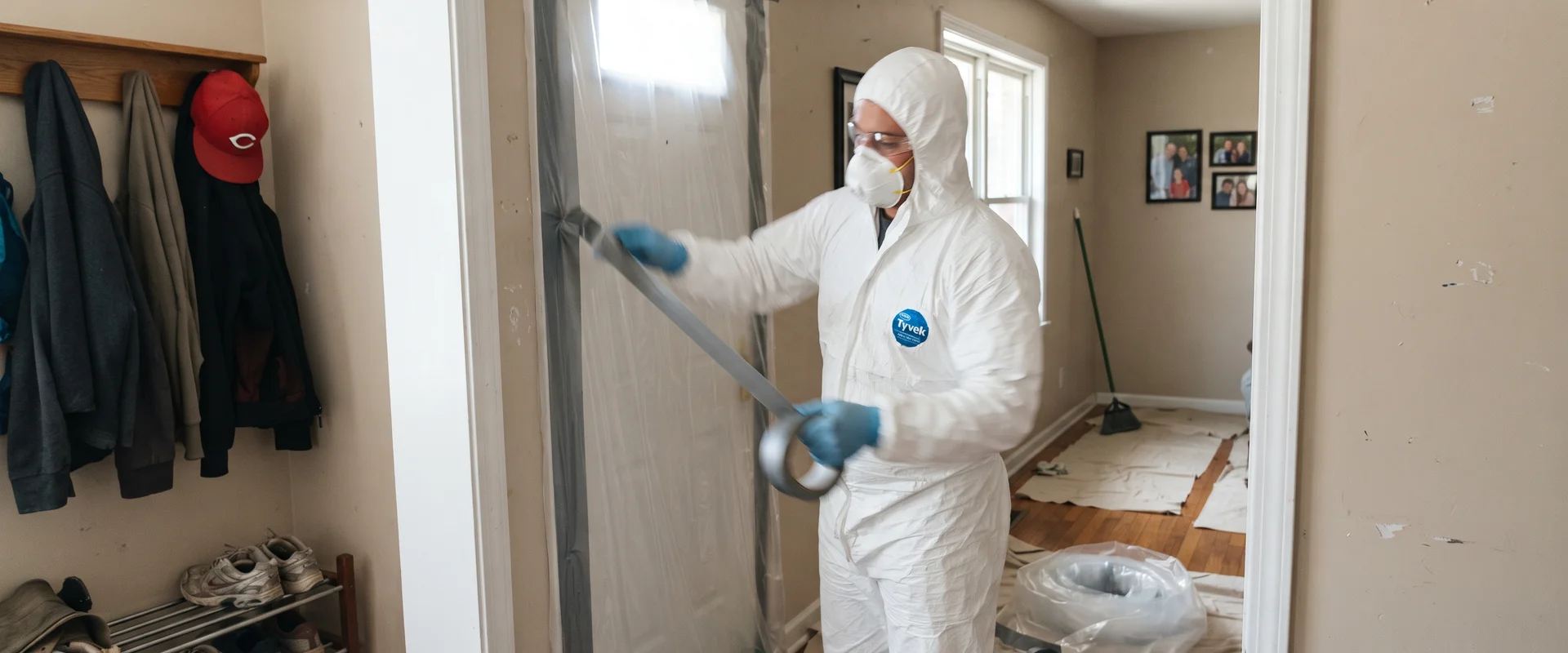
We check for strike-through below the flooring and clearly mark the boundary of the contaminated zone. Only then do containment barriers go up to protect the rest of the house. The work itself runs strictly to the US OSHA 29 CFR 1910.1030 bloodborne pathogens standard.
Crews wear full Tyvek suits and elastomeric respirators to stay safe. Cross-contamination barriers separate the work area from the rest of the home, and negative air machines keep anything airborne trapped safely inside the zone. Our technicians carefully cut out and remove contaminated porous materials instead of trying to treat them in place.
“Saturated carpet padding or a soaked wooden subfloor is just not something a liquid disinfectant can rescue. The only safe and effective option is complete removal to prevent future hazards.”
After the removal phase comes the deep decontamination process. Enzymatic cleansers break down organic residue to prepare the area. Then, technicians apply EPA-registered hospital-grade disinfectants and leave them on the surface for the exact contact time the product requires.
This is not just a quick spray and wipe. We finally run ATP, or Adenosine Triphosphate, verification testing on the treated surfaces to ensure total cleanliness. This scientific approach provides two major benefits:
- Objective Results: It gives a numerical reading of residual organic material instead of relying on a human judgment call.
- Immediate Correction: Anything that fails this test gets treated again on the spot.
Our process finishes by giving you post-remediation verification documentation when the job closes. This paperwork includes a waste manifest tracking sheet for every single container of regulated medical waste that left your property. Insurers, estate attorneys, and property managers always ask for that specific record.
Common Situations We Handle
Every situation requires a specific, measured response to ensure total safety. Our crews see a wide variety of incidents across the US, and each one demands specialized care.
The methods change slightly depending on the environment, but the goal always remains the same. Here is a closer look at the primary environments where professional remediation makes a massive difference.
Injury, medical emergency, and accident scenes
A fall, a sudden medical event, or an accident at home can leave significant blood contamination in a surprisingly small area. The CDC reports that over 14 million adults aged 65 and older experience a fall each year in the US. These falls result in nearly 3.85 million emergency room visits annually.
Our experience shows that these scenes are often handled by well-meaning family members who do not realize how far fluid has actually traveled. Blood easily seeps under heavy furniture, wicks into baseboards, or sinks deep into porous tile grout.
A common mistake is simply scrubbing the top layer of tile, which leaves trapped organic matter in the grout to cause severe odor issues a few weeks later. We remediate the full affected area, searching for hidden contamination rather than just cleaning the visible stain.
Industrial and workplace incidents
Workplace injuries create a strict legal obligation to restore the site safely and document the entire process. The US Bureau of Labor Statistics recorded 2.5 million nonfatal workplace injuries in private industry throughout 2024.
Our specialized protocol handles industrial and commercial scenes while providing the exact paperwork you need for compliance. This detailed documentation is suitable for your OSHA Form 300 recordkeeping and necessary insurance claims.
Business owners simply cannot afford the liability of asking uncertified employees to clean up a biohazard.
Hoarding environments with biohazard conditions
Living with severe clutter is incredibly difficult, and the situation can feel completely impossible to fix. Many hoarded homes cross the line from standard clutter into a biohazard through accumulated waste, spoiled food, pest activity, or bodily fluids.
The Institute for Challenging Disorganization uses a Clutter-Hoarding Scale to measure the severity of a home from Level 1 to Level 5. Level 3 on this scale is often the turning point where serious health and sanitation risks begin to appear.
When a home reaches these higher levels, the cleanup stops being a simple cleanout and becomes a true remediation project. Our technicians handle both the clutter removal and the biohazard decontamination in the exact same project. Our write-up of a hoarded West Chester ranch restored in two and a half days shows what that combined scope looks like on a real timeline. You deserve a safe, functional home, and we approach these sensitive cleanouts with absolute compassion and zero judgment.
Vehicles, rentals, and commercial spaces
Cars, rental units, and multi-tenant properties all need the same strict containment and disposal discipline as a single-family home. Vehicles present a highly unique challenge because their small, confined interiors trap heat.
High temperatures inside a parked car accelerate bacterial growth and rapidly increase pathogen loads, making the cleanup highly hazardous. We treat these confined spaces with our full safety protocol.
The entire process is kept completely discreet for the privacy of the owner and to avoid alarming the neighbors.
When Should You Call Instead of Cleaning Yourself?
Knowing when to step back is critical for your own physical and mental well-being. The Centers for Disease Control and Prevention recommends following Universal Precautions, which means treating all human blood and certain bodily fluids as if they carry infectious diseases.
Our advice is to always err on the side of caution. Call a professional team if there is visible blood or bodily fluid beyond a very small, fully contained amount like a simple cut. You should absolutely reach out if fluids have reached porous materials like carpet, upholstery, bare wood, or flooring seams. Getting help is also crucial if the person involved had an infectious condition, or if you simply do not know their medical history.
| Factor | DIY Cleanup | Professional Remediation |
|---|---|---|
| Tools & Equipment | Standard household cleaners, paper towels, regular trash bags. | EPA-registered hospital-grade disinfectants, ATP testing, biohazard bins. |
| Safety Gear | Basic gloves and maybe a paper mask. | Full Tyvek suits, elastomeric respirators, double-layer nitrile gloves. |
| Pathogen Risk | High risk of missed fluids in grout, baseboards, and subflooring. | Complete neutralization using OSHA-compliant bloodborne pathogen standards. |
| Waste Disposal | Illegal to throw regulated medical waste into regular municipal trash. | Licensed medical-waste disposal with full manifest tracking documentation. |
Another major factor is the psychological toll of the situation. Our crews often speak with overwhelmed family members who are trying to clean up after a loved one’s medical emergency.
Please call if the emotional weight of the scene is just too much to handle. That is a completely legitimate reason to ask for help on its own.
“A common insider tip from professional cleaners is to never rely on old, diluted household bleach. Once mixed with water, bleach degrades rapidly and loses its real disinfecting power within 24 hours.”
There is absolutely no charge to ask us a question about Biohazard & Trauma Scene Cleanup. The emergency helpline is answered around the clock by real people who understand what you are going through.
Our team will tell you honestly whether a situation needs professional remediation or if it is safe to handle yourself.
Call our 24/7 helpline today to protect your home, your family, and your peace of mind with the right facts.